
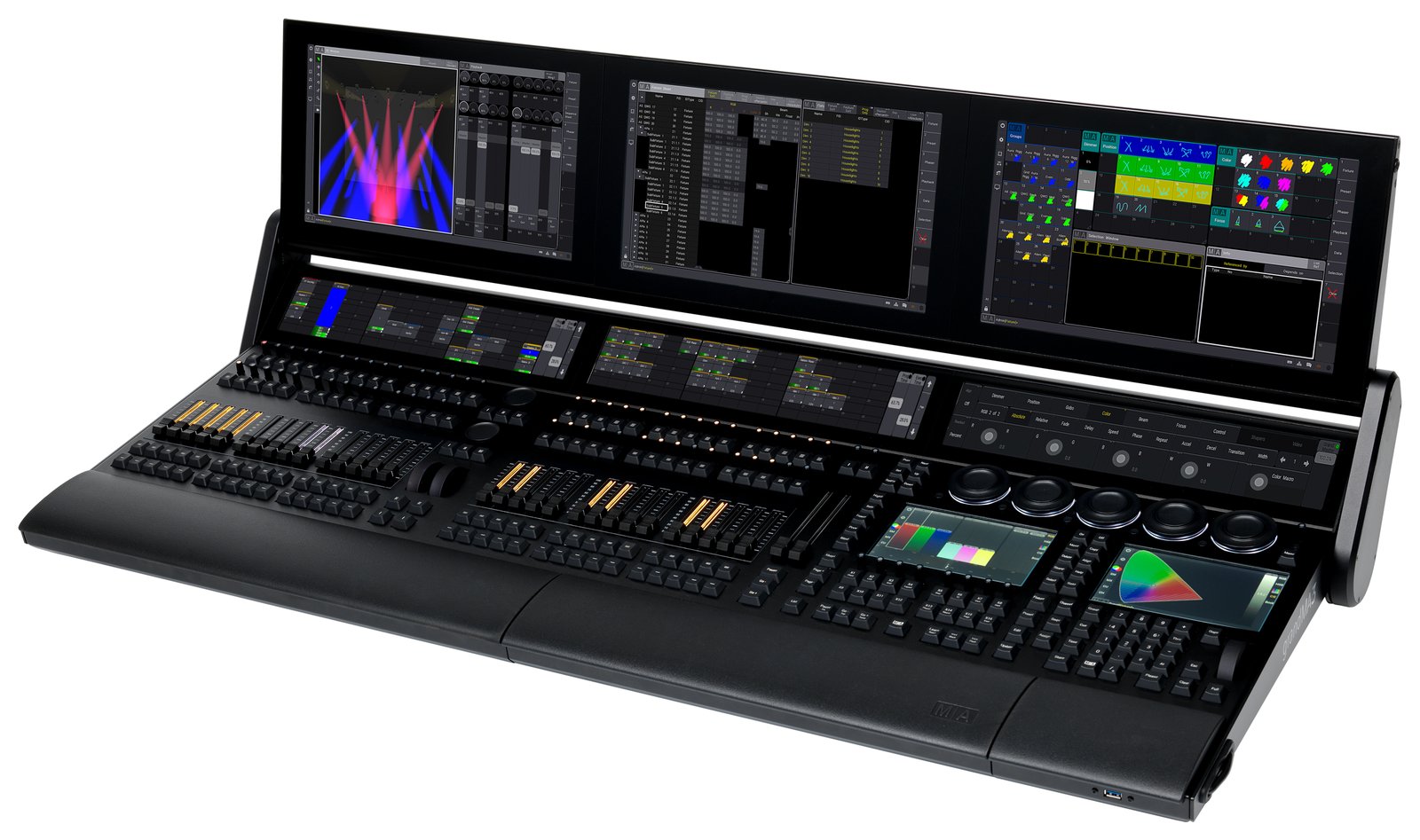
If there is one lighting console that dominates big tours, festivals and TV, it is the MA Lighting grandMA3. It is the rider standard at the very top of the industry — but also one of the deepest and most demanding desks to learn. What follows is an honest round-up of what lighting operators actually report, framed as a synthesis of community opinion rather than a hands-on test.
Where these takes come from
A synthesis of recurring opinions across English-speaking communities (r/lightingdesign, ControlBooth, the Blue Room) and working operators. See also our grandMA console guide. The framing stays honest throughout: this reflects what operators consistently say, not first-hand bench testing.
What operators love
It’s the industry standard
The number-one point in every discussion: grandMA is everywhere on big shows. Learn it and you can walk onto major tours, festivals and broadcast gigs, because the desk waiting for you is almost always an MA. Operators frame that ubiquity as a career advantage in itself — the skill travels with you to the highest-profile work in the industry, which is why so many aspiring ops target it first.
Immense power and scalability
From a single onPC setup on a laptop to vast networked rigs running over MA-Net, grandMA3 scales to the largest productions in the world. Operators rave in particular about the deep effects and “phaser” engine, which gives programmers enormous creative reach. Whatever the size of the show, the platform has the headroom — and that ceiling is a big part of why it sits at the top.
grandMA3 onPC is free to learn
You can download onPC and learn the software for free, with DMX output requiring nodes or a dongle. For students and aspiring operators, the community consistently calls this a huge deal: the exact environment used on the biggest shows is available to anyone willing to put in the hours at home.
Build and ecosystem
Rugged hardware, broad fixture support and an enormous global user base and training scene round out the appeal. Operators point to the depth of the ecosystem — the people, the training, the rental inventory — as being as much a part of the product as the desk itself.
What operators flag
1. A steep learning curve
The most repeated caveat: grandMA3 is deep and not intuitive at first. Operators are candid that you should expect serious time — and ideally formal training — before you are fast on it. The power is real, but so is the ramp to reach it.
2. Flagship cost
Full-size hardware is a major investment. This is top-tier money, and operators do not sugar-coat it: the desk sits at the premium end of the market, matching its position at the premium end of the industry.
3. The grandMA3 vs grandMA2 transition
A long-running community topic: early grandMA3 software lagged grandMA2 on features and stability, and many operators ran “MA2 mode” for years as a result. The platform has matured considerably since, but operators agree the transition is part of the story and shaped the desk’s reputation.
4. DMX output isn’t free with onPC
The onPC software is free, but real DMX output requires MA nodes or a dongle — so budget for that hardware path when you move from learning to actually driving fixtures.
5. Overkill for small gigs
For a small club or a single band, grandMA3 is far more console, and far more complexity, than the job needs. Operators regularly steer smaller productions toward simpler desks.
Who it’s really for
grandMA3 suits large-scale touring, festivals and broadcast — and anyone building a career where it is the expected desk. For theatre and cue work, many operators prefer ETC Eos; for value and busking, ChamSys. See our ETC guide and pro DMX controller guide.
My honest take
The editorial synthesis is that grandMA3 earns its crown for big shows and career ubiquity — immense power, and free onPC to learn on. Just go in expecting a real learning curve and flagship cost, and know that the MA2-to-MA3 transition shaped its reputation before the software matured. For the top tier of the industry, the community consensus is clear: it is the safe choice.
FAQ
Is grandMA3 hard to learn?
Yes — it is deep and not beginner-friendly. Plan for significant time and ideally formal training, helped by the free onPC software you can practice on at home.
Is grandMA3 onPC free?
The software is free to learn on; DMX output requires MA nodes or a dongle, so factor that hardware into your budget.
grandMA3 or ETC Eos?
grandMA for big-show, touring and busking ubiquity; ETC Eos for theatre and cue-based work. It is the classic divide, and the honest answer depends on the kind of shows you do.
Is it overkill for small venues?
Often yes — for small clubs and bands, a ChamSys or a compact desk is more practical and affordable than a full grandMA3.
Image: grandMA at front of house by Hullian111, CC BY-SA 4.0, via Wikimedia Commons.
Where to buy : MA Lighting grandMA3 full-size
| Retailer | Why | |
|---|---|---|
| Gear4music | Competitive price, European stock, fast delivery | See lighting consoles at Gear4music → |
| Amazon | Fast shipping, used and renewed units | See on Amazon → |
Affiliate links: the price is the same for you, the commission funds our tests. As an Amazon Associate we earn from qualifying purchases.
Read also: ETC vs High End Hog: Theatre Standard vs Concert Busker · Obsidian Onyx vs ChamSys MagicQ: The Free-Software Battle
Read also: ChamSys MagicQ MQ250M Stadium Review: Specs, Rivals, Verdict
Read also: grandMA3 compact vs compact XT: Which One Should You Buy?
Read also: Avolites Diamond 9 Review: D9-215 vs D9-330
Read also: Obsidian NX1-16 Review: The Compact Onyx Console
💡 Essential accessories for your lighting console
This page contains affiliate links. If you buy through them, we may earn a commission at no extra cost to you.
- DMX cable, 5-pin, 5 m : Stairville PDC5CC 5,0 m
- DMX terminator, 5-pin : Stairville DMX Terminator XLR 5-Pol
- DMX splitter, 2 outputs (3/5-pin) : Enttec D-Split (XLR 3 et 5 broches)
- USB gooseneck lamp : Adam Hall SLED 1 Ultra USB