
In the UK and across the touring world, professionals don’t say “controller” — they say lighting desk. The word itself is a signal: a desk is a serious programming and playback instrument for real production work, a world away from the cheap boxes sold to hobbyists. This guide explains what a professional lighting desk does, the platforms that matter, and how to choose one for your work. For the wider picture, see our guide to professional DMX lighting controllers.
Desk, console or controller?
They broadly describe the same thing, but the register differs. In the UK, the trade term is lighting desk; in the US, lighting console; “controller” is the catch-all that also covers entry-level and DJ gear. If a product leads on its low price, it isn’t a professional desk. The vocabulary is worth learning because it tells you who a product is aimed at: a manufacturer selling to touring professionals talks about desks and consoles, while one chasing the hobby market leads on how cheap and simple its controller is. When you read a spec sheet, that framing is a useful first filter before you even reach the feature list.
What a professional desk has to do
Whatever the badge, a desk earns its keep on a few things:
- Reliability and redundancy — it has to run a whole show without faltering, and offer a backup if the hardware fails, so a single fault doesn’t black out the stage.
- A pool of trained operators — on an industry-standard desk you can always find someone to programme or operate, and it’s often what the rider specifies in the first place.
- Networking and scale — real rigs run over Art-Net and sACN across many universes, distributing control over Ethernet rather than a tangle of separate DMX lines.
- Offline tools — a PC version to programme away from the venue and keep a backup ready on a laptop.
These are the qualities that separate a professional instrument from a toy, and they matter most precisely when things go wrong: the show that never stops, the operator who can always be replaced, the rig that scales without a rebuild, and the backup already programmed and waiting. None of them show up in a glossy photo, which is exactly why the hobby market rarely mentions them.
The desks that matter
- ETC Eos — the theatre standard, built around cue-based operation and a firm favourite in scripted work.
- grandMA (MA Lighting) — the touring and large-event standard, the rider default at the top end.
- ChamSys MagicQ — a British favourite, known for value and genuinely free software.
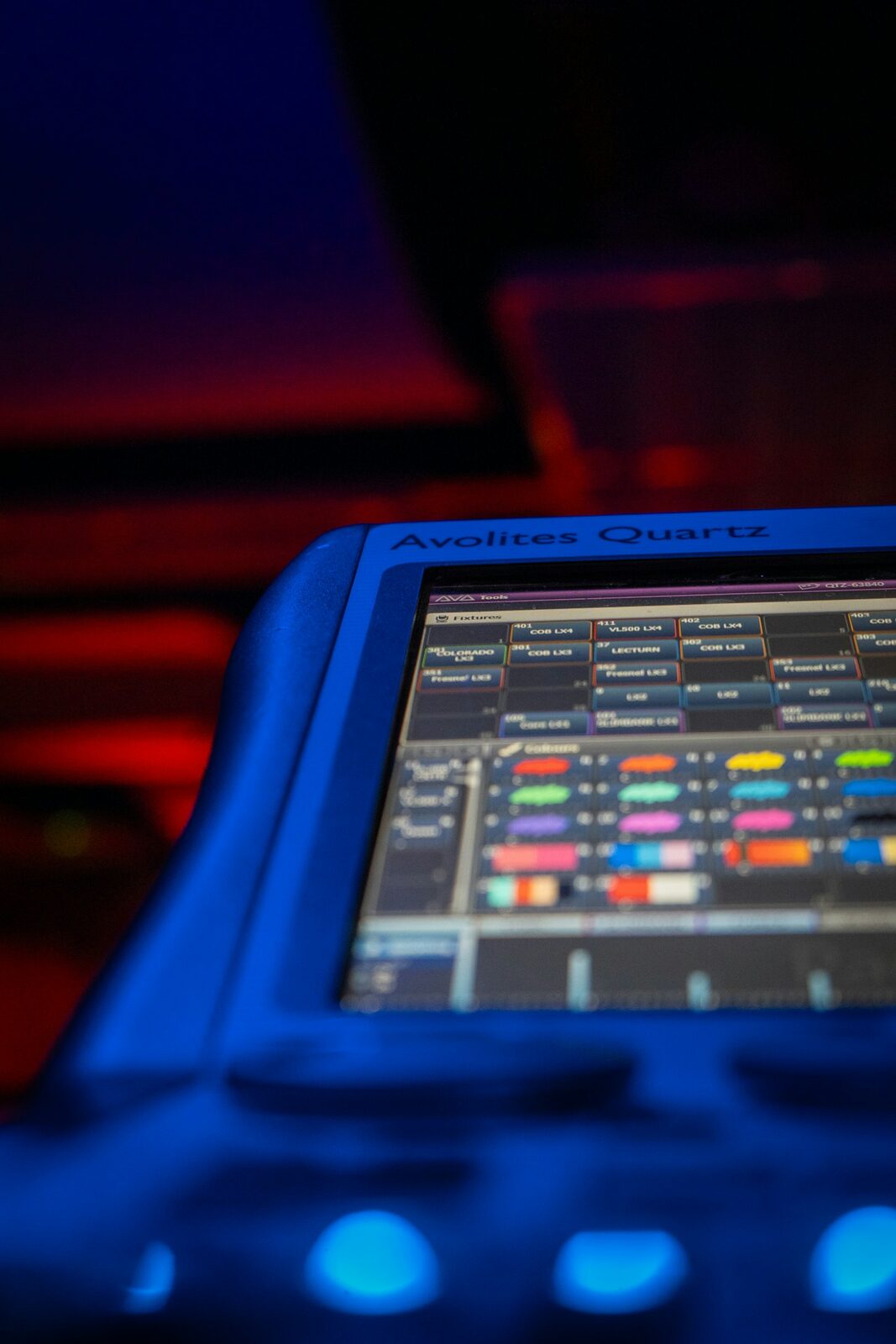
- Avolites — a British make with a strong following in events, on Titan software.
Between them these four cover the overwhelming majority of professional work, and each has carved out a home discipline — Eos in theatre, grandMA on the biggest tours, ChamSys and Avolites strong in live and events, particularly in the UK. Detailed model guides are on the way, but knowing the landscape is enough to start narrowing your choice.
Choosing a desk for your work
- Theatre — cue-based, repeatable programming: Eos territory, where writing a show once and replaying it identically is the whole job.
- Live and touring — fast, reactive operation: grandMA, Avolites or ChamSys, built for busking a show on the fly.
- Events — flexibility and quick turnarounds, where a desk you can programme fast and adapt on the day earns its keep.
Start from how you actually work, then weigh the criteria above. Don’t pick a desk on its feature list alone; pick it on the kind of shows you do and the pool of operators and rental gear around it, because the best instrument is the one you can staff, support and trust on the night. Our professional buyer’s guide takes you through the full decision.
FAQ
Is a lighting desk the same as a lighting console?
Yes — “desk” is simply the British term for what Americans call a console. Both mean a professional programming and playback instrument, and the difference is purely one of local vocabulary rather than the gear itself.
Which lighting desk should a smaller venue choose?
Look at how many fixtures you run and whether you need moving lights, then favour a desk with a healthy local pool of operators and solid support. A capable mid-range desk on a well-supported platform will serve a small venue far better than an underpowered box you’ll soon outgrow.
Photo credit: Unsplash
See lighting consoles on Gear4music →
This page contains affiliate links. If you buy through them, we may earn a commission at no extra cost to you.
💡 Essential accessories for your lighting console
This page contains affiliate links. If you buy through them, we may earn a commission at no extra cost to you.
- DMX cable, 5-pin, 5 m : Stairville PDC5CC 5,0 m
- DMX terminator, 5-pin : Stairville DMX Terminator XLR 5-Pol
- DMX splitter, 2 outputs (3/5-pin) : Enttec D-Split (XLR 3 et 5 broches)
- USB gooseneck lamp : Adam Hall SLED 1 Ultra USB