
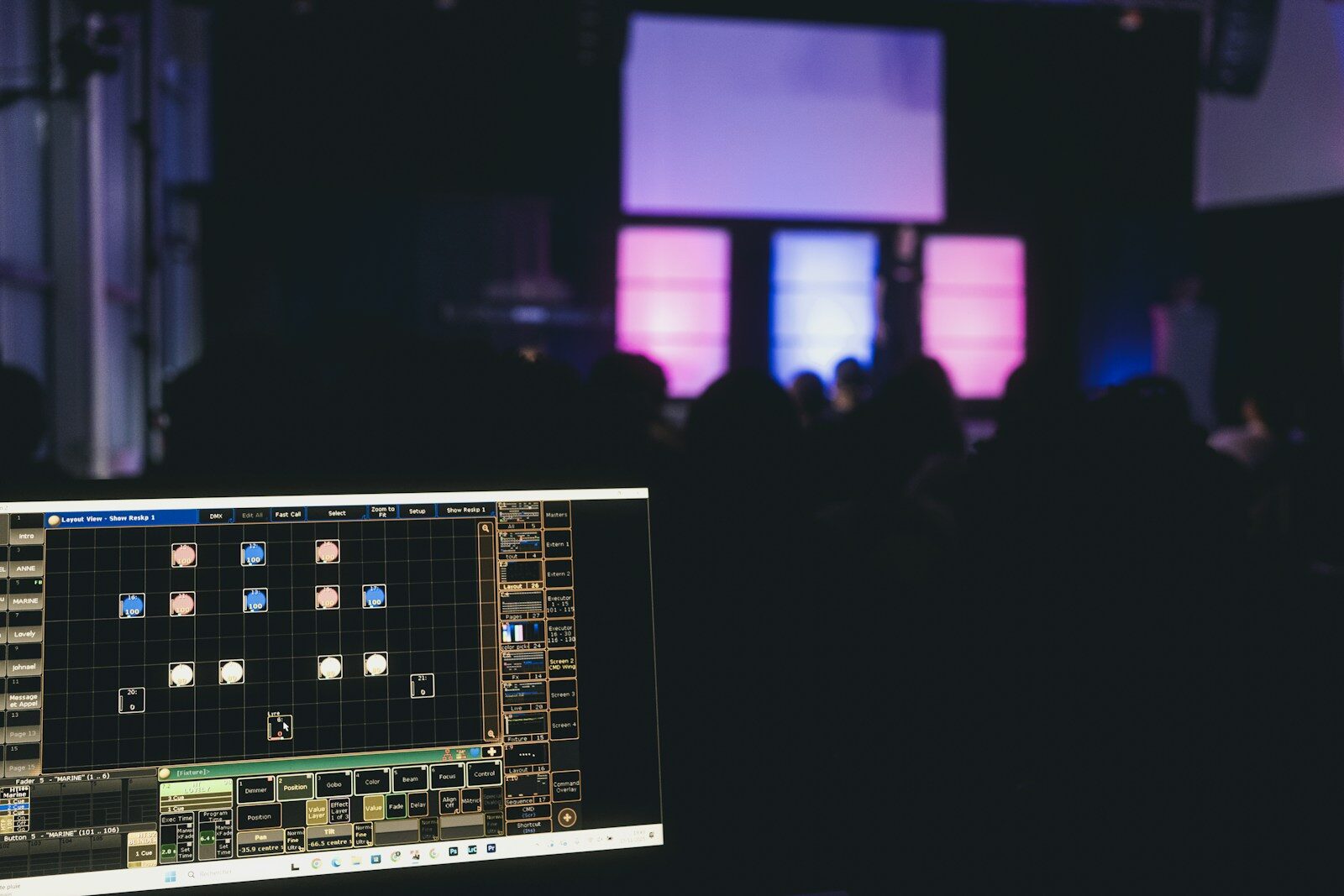
A DMX lighting control system is the whole chain that runs a stage or venue’s lighting: the console or controller, the network that carries the signal, the nodes that output DMX, and the fixtures themselves. Understanding it as a system — rather than fixating on the desk alone — is what separates a rig that behaves from one that fights you. This guide explains the parts, how they fit together, and clears up a common confusion about the name. For the control surface itself, see our guide to professional DMX lighting controllers.
Important: not building automation
“Lighting control system” on its own usually means building automation — the smart-home and architectural dimming world of Lutron and Crestron, where the goal is to schedule and scene-set the lights in a home, office or hotel. A DMX lighting control system is a different discipline entirely: it’s the entertainment-lighting world of stages, venues and shows, where the priority is live, cue-accurate control of intensity, color and movement. The two share the word “lighting” and little else, so if you’re researching gear it pays to be clear which universe you’re in before you compare products or read reviews.
The parts of a DMX system
- Console / controller — programs and plays back the show; this is the brain and the operator’s interface.
- Network — Art-Net / sACN carry many universes over standard Ethernet, so a single cable can transport what used to need dozens of separate DMX lines.
- Nodes — convert the network back to physical DMX near the fixtures, placing the output right where the lights hang.
- Fixtures — dimmers, LED washes, moving lights and everything else that turns instructions into photons.
The logic flows in one direction: the console builds and triggers looks, the network distributes them across the venue, the nodes hand off to real DMX cable, and the fixtures respond. Design the system so each stage has headroom — spare universes on the network, spare ports on the nodes — and expansion later becomes a matter of patching rather than rewiring.
Why the network layer matters
On a small rig you can run DMX straight from the console to the fixtures and never think about a network. As soon as the rig grows past a universe or two, though, Art-Net and sACN over Ethernet become the sensible backbone: they carry many universes down a single, cheap, easily replaced cable, and they let you place nodes wherever the fixtures are instead of dragging long DMX lines across a building. That architecture is also more resilient — a managed switch and a tidy addressing plan make faults easy to isolate, and adding a new zone is often just another node on the network. The tradeoff is that you now own a small data network, which rewards a little discipline around IP addressing, universe numbering and cable management.
For installations
In auditoriums and permanent venues, reliability and operation by non-specialists come first. An ETC system is a common choice, precisely because the whole chain — desk, gateways, dimming and networking — is designed to work together and to keep running with volunteers or house staff at the controls. In a fixed install the emphasis shifts away from raw programming power toward predictability: clear station control, simple presets for everyday events, and a system that a technician can hand over and trust to behave the same way months later.
FAQ
What’s a DMX lighting control system?
The end-to-end entertainment-lighting chain: console plus network plus nodes plus fixtures — not home or building automation. It’s the whole signal path from the operator’s fingertips to the light on stage.
Is DMX the same as a lighting control system?
DMX is the protocol — the language the signal is spoken in; the “system” is everything around it that generates, transports and acts on that signal. You can have DMX without a full networked system, but a modern venue system is built on DMX (and its networked cousins Art-Net and sACN).
Do I always need nodes and a network?
No. A small rig can run direct DMX from the console. Nodes and an Art-Net/sACN network earn their place once you outgrow one or two universes or need to distribute output across a large space.
Photo credit: Unsplash
Read also: Stage Lighting Control System: How It Works and How to Design One (Theater, Concert, Church)
See lighting consoles on Gear4music →
This page contains affiliate links. If you buy through them, we may earn a commission at no extra cost to you.
💡 Essential accessories for your lighting console
This page contains affiliate links. If you buy through them, we may earn a commission at no extra cost to you.
- DMX cable, 5-pin, 5 m : Stairville PDC5CC 5,0 m
- DMX terminator, 5-pin : Stairville DMX Terminator XLR 5-Pol
- DMX splitter, 2 outputs (3/5-pin) : Enttec D-Split (XLR 3 et 5 broches)
- USB gooseneck lamp : Adam Hall SLED 1 Ultra USB