
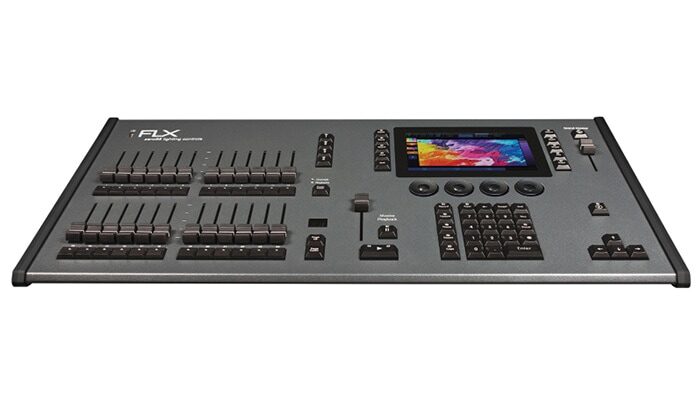
The Zero 88 FLX family — the full-size FLX (now discontinued) and its current successors, the compact FLX S24 and FLX S48 — has quietly become a fixture in schools, community theatres and small venues, and the reason comes up again and again in operator discussions: it is genuinely easy to learn, easy on the budget, and comfortable handling both cue-based theatre and live busking. That combination is rare at this price point, and it is why the desk keeps getting recommended to first-time buyers. What follows is an honest round-up of what operators actually report, not a hands-on lab test.
Where these takes come from
A synthesis of recurring opinions across English-speaking communities (r/lightingdesign, ControlBooth) and FLX operators in education and small venues. The framing throughout is deliberate: this is a distillation of community sentiment and the patterns that show up in threads and support forums, not a claim of first-hand bench testing.
What operators love
Genuinely easy to learn
This is the headline everywhere. The FLX is described as one of the most approachable serious consoles around, with a clean logic that new users grasp quickly. Operators repeatedly point out how well that suits environments where the person at the desk changes constantly — schools where students rotate through, volunteer-run community theatres, and houses of worship where the “LD” is whoever showed up. A console that a nervous first-timer can drive after a short handover has real institutional value, and the FLX earns that reputation.
Dual workflow: theatre and busking
The FLX handles cue-based theatre and playback/busking modes, and operators single this out as its defining strength. A multi-use venue that stages a scripted play one week and hosts a live band the next does not want two desks or two skill sets. Being able to run tracking cue stacks for a show and then busk faders and playbacks for an event, on the same familiar surface, is exactly what small mixed-use rooms need.
Affordable
Value comes up constantly. The FLX represents strong bang for the buck, and the more compact FLX S range pushes it within reach of genuinely tight budgets — the kind schools and volunteer groups actually work with. For many buyers it is the first “real” console they can justify.
Good support and ZerOS software
The FLX runs Zero 88’s ZerOS software and is backed by Zero 88, part of Signify’s entertainment brands alongside Vari-Lite and Strand Lighting. Operators report solid documentation, steady updates and dependable support behind the platform — reassurance that matters most to the institutions that buy it.
What operators flag
1. Aimed at small-to-mid shows
The most consistent caveat: the FLX is not built for the largest productions. Channel count, effects depth and fixture handling are less extensive than on flagship desks. For its target rooms that is a non-issue, but buyers eyeing large moving-light rigs should be clear-eyed about it.
2. Limited pro touring presence
You will not see the FLX on big tours the way you see grandMA or Hog. It is, by community consensus, an education and small-venue staple rather than a rider-standard touring desk — worth knowing if career ubiquity is part of your calculation.
3. Effects engine is modest
The effects engine is described as fine for most school and community work, but power users running complex moving-light shows will want more. It is a sensible trade for simplicity, not a hidden flaw — just match it to your material.
Who it’s really for
The FLX is ideal for schools, community and small theatres, and multi-use small venues that need an affordable, easy console for both cue and live work. It hits a sweet spot that flagship desks overshoot and basic controllers cannot reach. For bigger theatre, see our ETC Eos review and theatre console guide.
My honest take
Reading across the community, the Zero 88 FLX lands as an excellent value entry point — easy to learn, affordable, and flexible across theatre and live in a way few desks manage at this price. The editorial synthesis here is simple: buy it for small-to-mid work rather than big-show power, and it is one of the best choices going for education and community venues. Go in expecting a flagship and you will feel the ceiling; go in expecting an approachable, dependable all-rounder and it consistently delivers.
FAQ
Is the Zero 88 FLX good for beginners?
Yes — it is repeatedly described as one of the easiest consoles to learn, which is exactly why schools and community theatres gravitate to it. New operators tend to be productive quickly.
Can it do both theatre and live shows?
Yes — it offers cue-based theatre and playback/busking workflows on the same surface, which is what makes it such a good fit for multi-use venues juggling scripted shows and live events.
FLX or ETC Eos?
FLX for affordable, easy small-to-mid theatre and education; Eos for the bigger theatre standard, deeper programming and larger productions. They come from different companies (Zero 88 belongs to Signify, Eos to ETC) and target different scales.
What’s the difference between FLX and FLX S?
The FLX S (S24/S48) is the more compact, budget-friendly range; the original full-size FLX was the larger model, but it is now discontinued and Zero 88 points buyers to the S24 and S48. Skills carry across the family, so starting on an S is not a dead end.
Photo credit: Photo: Zero 88 / Vari-Lite (zero88.com)
Where to buy : Zero 88 FLX S48
| Retailer | Why | |
|---|---|---|
| Thomann | Reference price, 3-year warranty, pro stock in Europe | Check price at Thomann → |
| Amazon | Fast shipping, used and renewed units | See on Amazon → |
Affiliate links: the price is the same for you, the commission funds our tests. As an Amazon Associate we earn from qualifying purchases.
Read also: ETC ColorSource Review: ETC Quality, Simply
💡 Essential accessories for your lighting console
This page contains affiliate links. If you buy through them, we may earn a commission at no extra cost to you.
- Dust cover : Vari-Lite FLX S48 Dust Cover
- DMX cable, 5-pin, 5 m : Stairville PDC5CC 5,0 m
- DMX terminator, 5-pin : Stairville DMX Terminator XLR 5-Pol
- DMX splitter, 2 outputs (3/5-pin) : Enttec D-Split (XLR 3 et 5 broches)
- USB gooseneck lamp : Adam Hall SLED 1 Ultra USB