
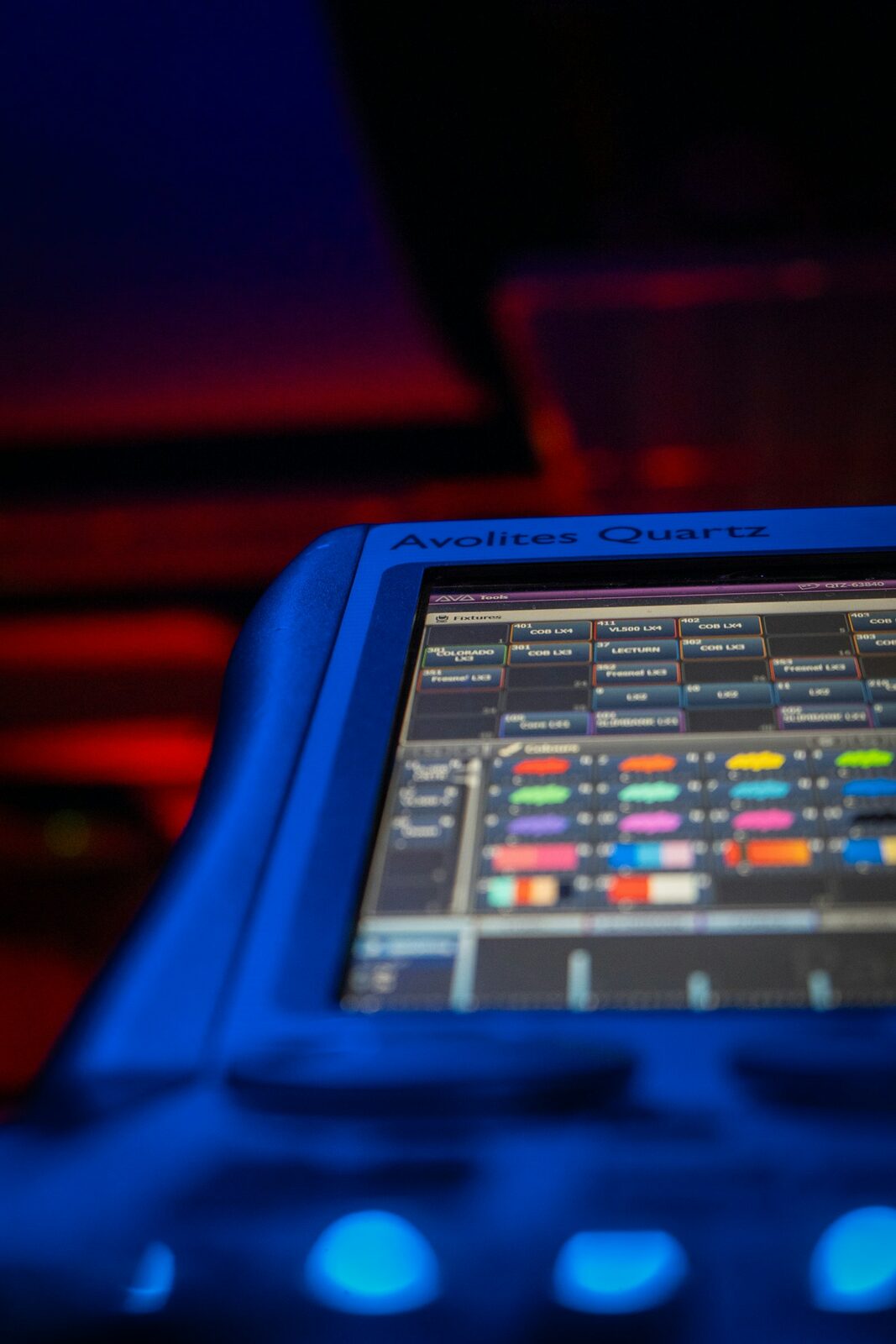
Search “DMX controller” online and you’ll drown in eighty-dollar DJ boxes and free software dongles. None of them will get you through a show that actually matters. This guide is for working professionals — theatre, touring, corporate and live events — who need a console they can trust under pressure. We’ll cut through the hobbyist noise, define what “professional” really means in lighting control, and map the platforms the industry actually runs on. New to all this? Start with what a DMX controller actually is.
Controller, console or desk?
The words matter, because they signal who a product is built for.
- In the US, working professionals talk about a lighting console (or, loosely, a controller).
- In the UK and much of the touring world, it’s a lighting desk.
- The cheap “DMX controllers” that flood online stores — DJ-oriented boxes, basic fixture controllers, free software with a USB dongle — are a different world entirely.
A professional console is a programming and playback instrument built for reliability, scale and repeatability. If a product’s headline feature is its price, it isn’t one.
What makes a controller “professional”?
Forget the spec sheet for a moment. These are the things that decide whether a console survives real production work.
- Reliability and redundancy. Can it run for weeks without a reboot — and what happens if it fails mid-show? Professional platforms offer backup / tracking redundancy so a single hardware fault doesn’t kill the lights.
- A trained-operator ecosystem. A console is only as good as the person driving it. Industry-standard platforms mean you can always find someone to operate, cover or take over — and they’re often what the rider demands.
- Network and scale. Real rigs run over Art-Net and sACN, addressing dozens of universes. The number of outputs (parameters) a console can drive defines the size of show it can handle.
- Software and offline tools. Professional platforms run on a PC (onPC / software) so you can program offline, train an operator, or keep a backup ready without the full desk.
- Total cost of ownership. The sticker price is the tip of the iceberg: training, wings and extensions, maintenance and resale value all count. A “cheap” console nobody can operate costs more than a well-run standard.
The professional platforms at a glance
A handful of platforms run the professional world:
- ETC Eos — the theatre standard, built around cue-based (tracking) operation.
- grandMA (MA Lighting) — the de facto touring and large-event standard.
- ChamSys MagicQ — known for value and accessibility.
- Avolites — a strong presence in events and touring, on Titan software.
- Hog / High End Systems — established in live events, especially in the US.
Each of these deserves its own deep dive — dedicated model guides are on the way.
Which console for which job?
The “best” console depends entirely on the work you do:
- Theatre / cue-based shows → ETC Eos territory: write a show once, play it back identically every night.
- Touring / live busking → grandMA, Avolites or ChamSys, built for reactive, on-the-fly operation.
- Corporate & events → flexible, fast platforms with strong network support and quick turnarounds.
- Fixed install → reliability and operation by non-specialists come first.
- Churches & houses of worship → easy operation for volunteers, repeatable services, livestream-friendly.
Use-case guides covering each of these are on the way.
Software and wireless control
Two areas worth flagging early:
- Control software. Every major platform ships a PC version (Eos Nomad, MagicQ PC, Hog PC, grandMA onPC) for offline programming and backup.
- Wireless DMX. Professional wireless relies on standards like W-DMX and LumenRadio CRMX — a different league from the cheap wireless boxes sold to hobbyists.
FAQ
Is a DMX controller the same as a lighting console?
Loosely, yes — but in professional use, “console” (or “desk” in the UK) implies a serious programming and playback instrument, while “controller” often refers to entry-level or DJ gear. Intent matters more than the label.
What consoles do professionals actually use?
On major tours, in theatre and in broadcast, you’ll most often find ETC Eos and grandMA, with ChamSys and Avolites widely used across events.
What’s the most affordable way into a professional console?
The software route. Run a platform’s PC version (onPC / Nomad / MagicQ PC) with a hardware node or wing: you learn the real environment for a fraction of the price of a full desk.
The bottom line
Choosing a professional DMX lighting controller isn’t about finding the “best” box — it’s about matching a platform’s workflow, ecosystem and reliability to the work you actually do. Start from your use case, weigh the criteria above, and never treat redundancy as an afterthought.
Photo credit: Unsplash
Where to buy : MA Lighting grandMA3 light
| Retailer | Why | |
|---|---|---|
| Gear4music | Competitive price, European stock, fast delivery | See lighting consoles at Gear4music → |
| Amazon | Fast shipping, used and renewed units | See on Amazon → |
Affiliate links: the price is the same for you, the commission funds our tests. As an Amazon Associate we earn from qualifying purchases.
Read also: Stage Lighting Control System: How It Works and How to Design One (Theater, Concert, Church)
Read also: Hog Lighting Consoles in 2026: Tour Hog, Stage Hog and Flex Hog
Read also: grandMA3 onPC Guide: Free Software, DMX Keys, Nodes and Wings
💡 Essential accessories for your lighting console
This page contains affiliate links. If you buy through them, we may earn a commission at no extra cost to you.
- DMX cable, 5-pin, 5 m : Stairville PDC5CC 5,0 m
- DMX terminator, 5-pin : Stairville DMX Terminator XLR 5-Pol
- DMX splitter, 2 outputs (3/5-pin) : Enttec D-Split (XLR 3 et 5 broches)
- USB gooseneck lamp : Adam Hall SLED 1 Ultra USB