
DMX512 is the protocol that tells stage lights what to do. Every professional lighting console, from a small DMX controller to a grandMA3 full-size, speaks it, and almost every intelligent fixture listens to it. If you understand how DMX512 works, you can patch a rig faster, avoid most signal problems and make better buying decisions. Here’s the protocol explained without the jargon overload.
A short history
DMX512 was created in 1986 by USITT (the United States Institute for Theatre Technology) to replace the tangle of incompatible, often analog, dimmer control systems of the time. The name stands for Digital Multiplex with 512 channels. The standard is now maintained by ESTA and was approved as ANSI E1.11 (USITT DMX512-A) in 2004. It has been revised since: the current edition listed by ESTA is ANSI E1.11-2024.
Almost four decades later, it is still the common language of stage lighting. Newer network protocols like Art-Net and sACN carry DMX data over Ethernet, but at the fixture end, the logic is still DMX512.
How DMX512 works
Universes and channels
A single DMX line is called a universe. Each universe carries 512 channels (the standard calls them slots), and each channel holds a value between 0 and 255. A simple dimmer uses one channel for intensity; an RGB LED par might use three or more; a moving head can use dozens, depending on its DMX mode.
When a fixture needs more than 256 steps of precision, for example for smooth pan and tilt, manufacturers combine two channels into a 16-bit parameter. That’s why a “fine” channel often sits next to pan and tilt in a fixture’s DMX chart.
Once a rig outgrows 512 channels, you add universes. Our guide on how many DMX universes you need shows how to count them.
The data stream
DMX512 is a one-way serial protocol. The console sends a continuous stream of packets at 250 kbit/s, each byte framed with one start bit, eight data bits and two stop bits. Each packet starts with a break and a mark-after-break, then a start code (slot 0), followed by up to 512 data slots.
A full 512-channel packet takes about 23 ms to send, which gives a maximum refresh rate of about 44 Hz. That is fast enough for smooth fades and chases, and it is why the console keeps resending every value, many times per second, even when nothing changes.
Addressing
Each fixture has a start address. If a fixture in a 10-channel mode is set to address 1, it uses channels 1 to 10; the next fixture starts at 11. The console’s patch links each fixture in your show to its universe and start address. A wrong address or a wrong DMX mode is one of the most common causes of “my light is doing something strange.”
The physical layer: cables, connectors and termination
| Specification | DMX512 value |
|---|---|
| Electrical standard | EIA-485 (RS-485) differential signaling |
| Data rate | 250 kbit/s |
| Channels per universe | 512, values 0 to 255 |
| Max refresh (512 channels) | about 44 Hz (about 23 ms per packet) |
| Cable impedance | 120 Ω, shielded twisted pair |
| Termination | 120 Ω resistor at the end of the line |
| Devices per line | up to 32 unit loads |
| Recommended line length | about 400 m (1,300 ft) |
| Official connector | 5-pin XLR |
Daisy chains and unit loads
DMX runs as a daisy chain: console to fixture one, fixture one to fixture two, and so on. The standard allows up to 32 unit loads on one line, which in practice means about 32 standard receivers. If you need more, or you need to branch the signal, use an opto-isolated splitter rather than a Y-cable.
Cable: why microphone cable is a bad idea
DMX needs cable with a characteristic impedance of 120 Ω. Microphone cable looks similar and uses the same XLR connectors, but it isn’t designed for this impedance, and on longer runs or larger rigs it causes reflections and flicker. Our guide to choosing DMX cables explains what to look for.
5-pin vs 3-pin XLR
The standard specifies 5-pin XLR connectors; 3-pin XLR is explicitly not allowed by the standard, even though many budget and mid-range fixtures use it. In real rigs you’ll often need 3-to-5-pin adapters. They work, but they are also a common failure point.
Termination
The last device on each line should have a 120 Ω terminator plugged into its DMX output. Without it, the signal can reflect back down the cable and cause random flickering or fixtures that react to the wrong values. A terminator costs very little and prevents many problems.
DMX512, RDM and network protocols
DMX512 is one-way: the console talks, fixtures listen. RDM (Remote Device Management, ANSI E1.20, first published in 2006 and now in its 2025 edition) adds two-way communication over the same pair of wires (pins 2 and 3), so a console can read a fixture’s status, change its address or mode remotely, and discover what’s connected.
For large rigs, consoles output Art-Net or sACN over Ethernet, and nodes convert those streams back to DMX near the fixtures. One DMX universe carried as sACN needs only about 0.23 Mbit/s, so even 64 universes stay around 15 Mbit/s, well within a standard network. Wireless systems such as CRMX and W-DMX also carry DMX; see our wireless DMX guide. And modern file formats like GDTF and MVR make patching DMX fixtures easier; our explainer on GDTF and MVR covers them.
When things go wrong
Most DMX faults come from a short list: missing termination, microphone cable, too many devices on one line, damaged connectors, wrong addresses or DMX modes, and Y-splits without a splitter. Our checklist of common DMX problems and fixes walks through each one, and if you’re just starting out, our explainer on what a DMX controller is is the natural next read.
Key takeaways
- DMX512 dates from 1986 (USITT) and is standardized as ANSI E1.11 since 2004.
- One universe = 512 channels, each with a value from 0 to 255, refreshed up to about 44 times per second at 250 kbit/s.
- Use 120 Ω DMX cable, terminate every line with 120 Ω, stay within 32 unit loads and about 400 m.
- 5-pin XLR is the official connector; 3-pin is common but non-standard.
Frequently asked questions
What does DMX512 stand for?
DMX512 means Digital Multiplex with 512 channels. It was created by USITT in 1986 and is standardized as ANSI E1.11.
How fast is DMX512?
It runs at 250 kbit/s. A full 512-channel packet takes about 23 ms, which gives a maximum refresh rate of about 44 Hz.
How many fixtures can I put on one DMX line?
The standard allows up to 32 unit loads per line. Beyond that, or to branch the signal, use an opto-isolated DMX splitter.
Can I use 3-pin XLR for DMX?
The standard specifies 5-pin XLR and does not allow 3-pin, but many fixtures use 3-pin anyway. It works electrically with proper 120 ohm DMX cable, usually via adapters.
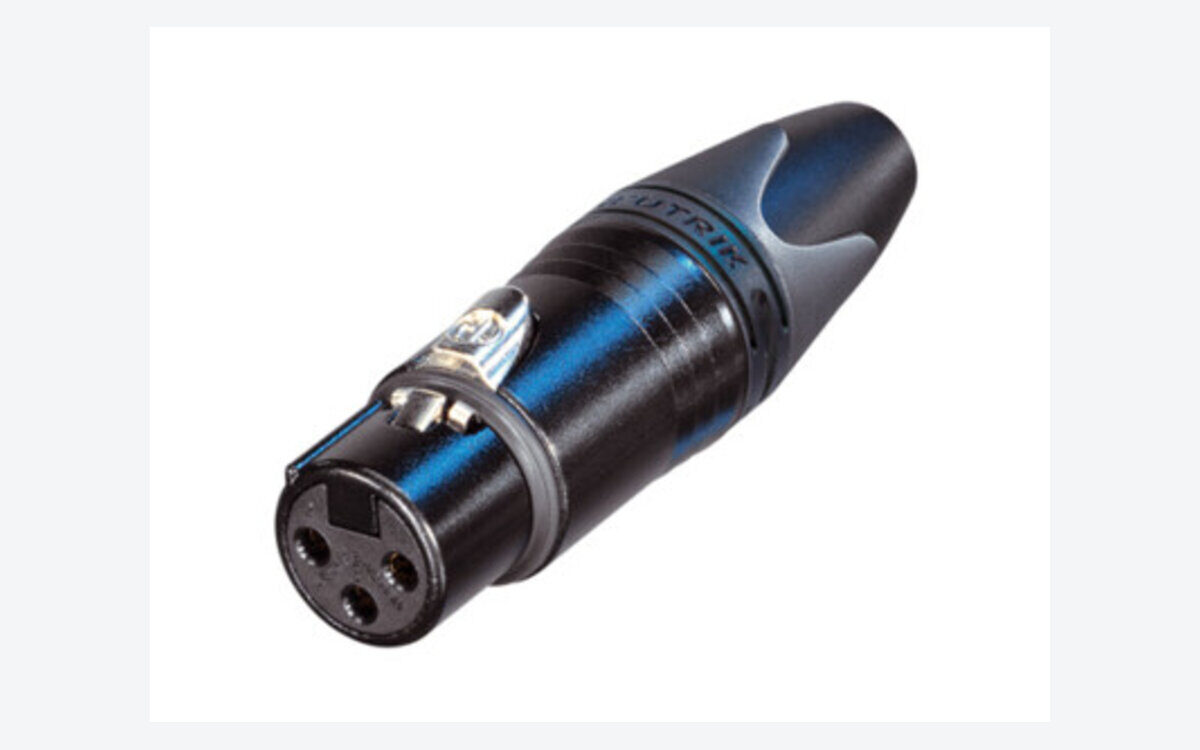
Photo credit: Neutrik
Sources — Wikipedia – DMX512, ESTA – Published standards (ANSI E1.11, E1.20).
See DMX cables on Gear4music →
This page contains affiliate links. If you buy through them, we may earn a commission at no extra cost to you.
💡 Essential accessories for your lighting console
This page contains affiliate links. If you buy through them, we may earn a commission at no extra cost to you.
- DMX cable, 5-pin, 5 m : Stairville PDC5CC 5,0 m
- DMX cable, 3-pin, 5 m : Stairville PDC3CC 5,0 m
- DMX terminator, 5-pin : Stairville DMX Terminator XLR 5-Pol
- DMX terminator, 3-pin : Stairville DMX Terminator XLR 3-Pol
- DMX splitter, 2 outputs (3/5-pin) : Enttec D-Split (XLR 3 et 5 broches)