
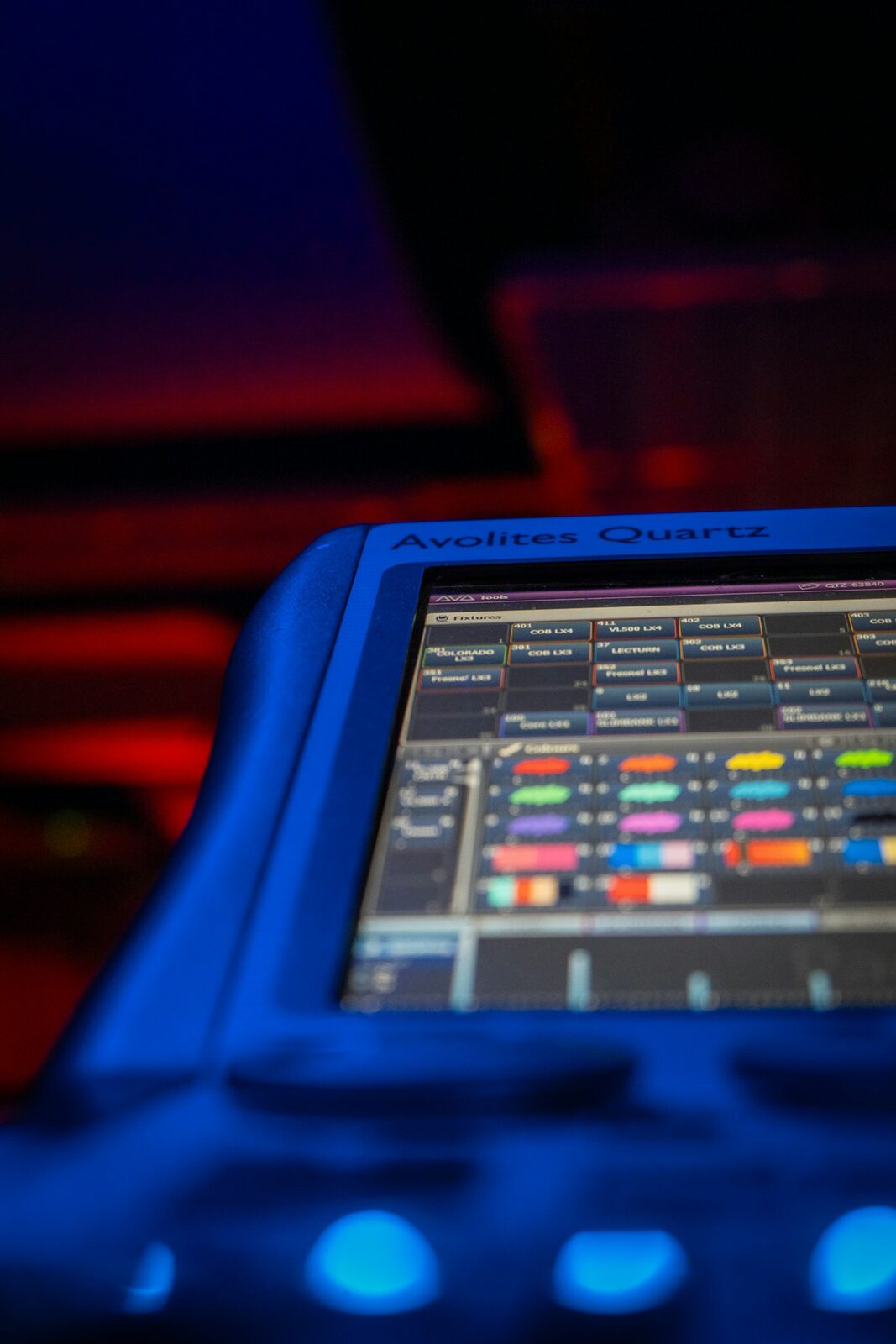
A stage lighting control system is everything between the operator’s hands and the light on stage: the console, the control protocol, the network that carries it, the devices that distribute it and the fixtures or dimmers that act on it. Most buying mistakes happen because people choose a console first and discover the network, the nodes and the fixture modes afterwards. This guide takes the system as a whole, from a school theater to a concert stage, and links to our rated console reviews where a specific model matters.
The five layers of a lighting control system
- The controller: a lighting console (ETC Eos, grandMA3, ChamSys MagicQ, Avolites, Hog, Zero 88 FLX) or control software on a computer with a wing or a USB node. See our professional DMX controller guide and control software guide.
- The protocol: DMX512 on 5-pin XLR for the last meters, and Art-Net or sACN over Ethernet for the backbone. sACN (E1.31) is the professional choice for multi-universe systems because it multicasts per universe and handles priorities.
- Distribution: Ethernet switches, DMX nodes (network to DMX), splitters and boosters (opto-isolated), and wireless links (CRMX, W-DMX) where cable is impossible. Our guide on how many DMX universes you need explains the sizing.
- Power and dimming: dimmer racks for conventional fixtures, relay or constant-power modules for LED and moving lights, all addressed on the same universes.
- Fixtures: LED washes, profiles, moving heads and effects, each consuming a DMX footprint that depends on its mode. Sixteen-bit modes use two channels per parameter (coarse and fine), raising resolution from 256 to 65,536 steps at the cost of a larger footprint.
Sizing the system: universes, nodes and headroom
Start from the fixture list, not from the console. Add the channel count of every fixture in the mode you will actually use, divide by 512 and round up to the next universe. Then add 30 percent headroom for guest rigs and future purchases. A 200-seat theater with 24 LED profiles, 16 washes and a few effects usually lands at two to three universes; a festival stage with 60 moving heads and LED video elements needs eight or more. Every universe must reach the stage physically: plan one node port per universe, plus a spare, and keep DMX lines under 32 devices and roughly 300 meters with a terminator at the end. For the failure cases you will meet, read common DMX problems and how to fix them.
Theater, concert, church: three typical systems
Theater and performing arts center
Cue-list workflow, long shows, fixed network. The reference is the ETC Eos family (Element 2 for a school, Ion Xe for a regional theater, Gio or Apex for a large house) with sACN nodes in the grid and dimmer or relay racks. Zero 88 FLX S48 is the budget alternative. Our guides: theatre lighting consoles and ETC Eos consoles compared.
Concert stage and touring
Busking workflow, fast programming, redundancy. grandMA3 (light or full-size) is the rider standard, ChamSys MagicQ MQ500M the value leader, Avolites and Hog the operator favorites. Networks use redundant Ethernet lines to stage racks holding the nodes, with a backup console or onPC session running the same show file. See stage lighting controllers and grandMA consoles.
Church and house of worship
Volunteer operators, weekly services, occasional concerts. ETC ColorSource 40, ChamSys QuickQ 30 or Obsidian Onyx with an NX Touch cover most rooms, with a simple sACN network and a handful of LED fixtures in 8-bit modes to keep programming easy. Our dedicated church stage lighting guide goes into the details.
What a lighting control system costs
| System | Console | Network and distribution | Typical total (excl. fixtures) |
|---|---|---|---|
| School or church, 1–2 universes | QuickQ 20/30, ColorSource 20/40, FLX S24: 1,500–4,000 USD | 2-port node, splitter, cabling: 500–1,200 USD | 2,000–5,000 USD |
| Regional theater, 2–4 universes | Ion Xe, FLX S48, MagicQ MQ70: 5,000–12,000 USD | 4-port nodes, switches, backup PC: 2,000–5,000 USD | 7,000–17,000 USD |
| Concert stage / tour, 8+ universes | grandMA3 light, MQ500M, Diamond 9: from around 25,000 USD to well over 60,000 USD depending on model | Network processors, 8-port nodes, redundant lines: 6,000–15,000 USD | from around 30,000 USD, often much more |
Prices are indicative street-price ranges and vary widely by region, dealer and configuration, so check current quotes; nodes, switches, cabling and a backup add significantly to the console budget.
Choosing the controller last
Once the system is sized, the console choice becomes simple: match the workflow (cue list versus busking), the universe count with 30 percent headroom, the network protocol your nodes and fixtures speak, and the operators’ skills. Our beginner console guide, under-1,000 USD guide and DMX control system guide cover the three most common budgets.
FAQ
What is a stage lighting control system?
It is the chain that turns an operator’s decisions into light on stage: a lighting console or software, a DMX or network signal path (Art-Net, sACN), distribution devices (nodes, splitters) and the fixtures or dimmers that receive the data.
How many DMX universes does a stage need?
Count the DMX channels of every fixture in its chosen mode and divide by 512. A small theater with 40 LED fixtures in 16-channel modes needs about two universes; a mid-size concert stage with moving heads typically needs four to eight.
Do I need a console or is software enough?
Software (grandMA3 onPC, MagicQ PC, Onyx, Eos Nomad) with a USB node or wing is enough for fixed installs, small venues and programming. For live busking and touring, a hardware console with faders and executors is faster and more reliable.
Is a theater lighting control system different from a concert one?
The components are the same. Theater favors cue-list consoles (ETC Eos, Zero 88 FLX) and fixed networks; concerts favor busking consoles (grandMA3, MagicQ, Avolites) and portable racks with redundant lines.
Affiliate links: the price is the same for you, the commission funds our tests. As an Amazon Associate we earn from qualifying purchases.Where to buy : MA Lighting grandMA3 light
Retailer Why Gear4music Competitive price, European stock, fast delivery See lighting consoles at Gear4music → Amazon Fast shipping, used and renewed units See on Amazon →
💡 Essential accessories for your lighting console
This page contains affiliate links. If you buy through them, we may earn a commission at no extra cost to you.
- DMX cable, 5-pin, 5 m : Stairville PDC5CC 5,0 m
- DMX terminator, 5-pin : Stairville DMX Terminator XLR 5-Pol
- DMX splitter, 2 outputs (3/5-pin) : Enttec D-Split (XLR 3 et 5 broches)
- USB gooseneck lamp : Adam Hall SLED 1 Ultra USB