💡 Expert tests, comparisons & guides • DMX · Art-Net · RDM • From club to theatre

Author: Patrice.C

  • MA Lighting Consoles Explained: the grandMA Maker

    MA Lighting Consoles Explained: the grandMA Maker

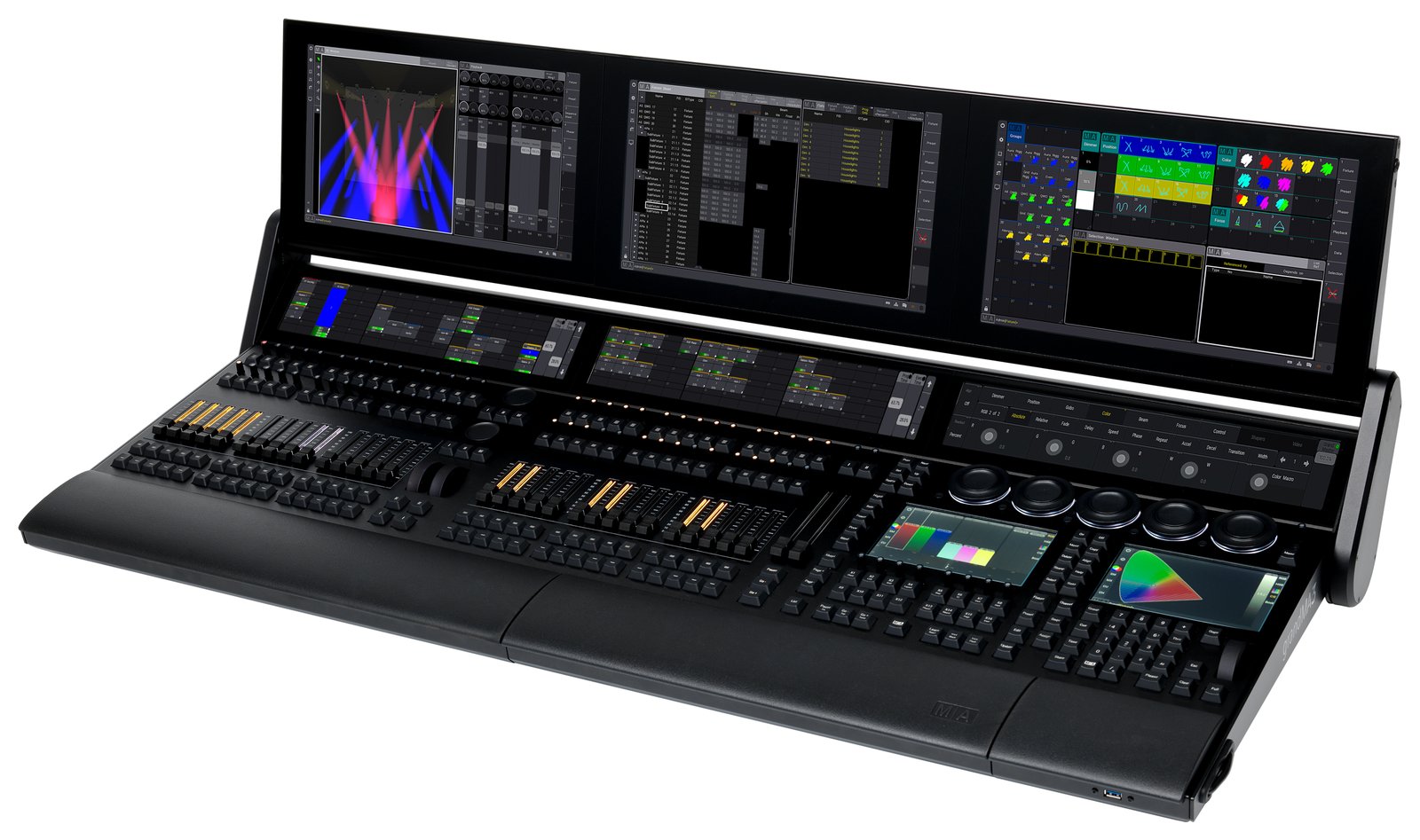
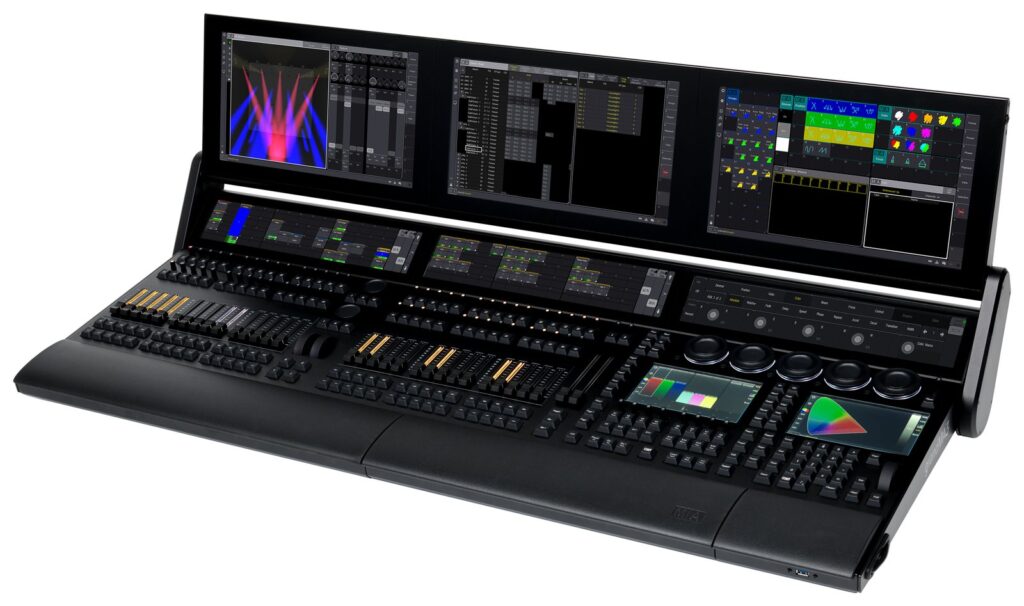
    MA Lighting is the German manufacturer behind the grandMA series — one of the most influential names in professional lighting control, found on major tours, festivals, broadcast productions and theatre rigs worldwide. Few companies have shaped how large shows are programmed as much as this one. This is the brand overview; for the consoles themselves, see our grandMA console guide. For the wider landscape of professional control, see our professional buyer’s guide.

    The company and the standard

    Based in Germany, MA Lighting built its reputation on the grandMA platform, which became a de facto control standard for large-scale live production. When a rider specifies “MA,” this is the ecosystem it means — and that single line on a contract tells you a great deal about how deeply the platform has embedded itself in the touring world. A rider standard is self-reinforcing: because the biggest shows call for it, rental houses stock it, operators train on it, and the next production specifies it too. The result is a platform you encounter again and again as you move up through festival and concert work, which is why understanding the maker behind the desk is worth the time even before you touch the hardware.

    The product line

    • grandMA3 — the current generation, with an integrated 3D visualizer and native GDTF support built into the workflow.
    • grandMA2 — the previous generation, still widely used on tours and strong on the second-hand market.

    The two generations coexist in the field far more than is usual in this industry: a huge installed base of grandMA2 desks is still working nightly, while grandMA3 represents where the platform is heading. For anyone weighing a purchase, that overlap is important, and the full detail on models, forms and where each fits lives in our grandMA console guide.

    The ecosystem

    Part of MA’s strength sits around the console rather than inside it. The MA University training program is certified worldwide and blends e-learning with hands-on classes, which keeps a steady stream of trained operators entering the market — exactly the pool a rider standard depends on. The onPC software lets you program offline on a laptop and keep a ready backup, so a designer can build a whole show before ever reaching the venue. And the open GDTF fixture standard, which MA co-created with Robe and Vectorworks, aims to make fixture data portable across tools and platforms instead of locked inside one manufacturer’s library. Taken together, the training, the software and the open data standard are as much the product as the desk. (Sources : MA Lighting.)

    Why the ecosystem matters when you choose

    When you commit to a control platform, you’re not just buying hardware — you’re buying into a labor market, a training path and a supply of rental gear. MA scores well on all three: operators are findable, courses are structured and recognized, and inventory is easy to rent or sub-hire almost anywhere large productions happen. That reduces risk on a big show, because a failed desk can be swapped and a sick operator replaced without rewriting the whole approach. It’s the same logic that makes an industry standard hard to displace, and it’s the reason the MA name carries weight far beyond the specifications of any single model. For a buyer, that means the smart question isn’t only “how good is this desk?” but “how easy will it be to staff, rent and support in the market I actually work in?” — and on that measure MA is hard to beat.

    Le Faisceau Rating — MA Lighting consoles

    Rated with our Le Faisceau rating method (capacity 25% · programming and workflow 30% · ecosystem and networking 15% · value for money 20% · reliability and support 10%). Specs and prices sourced from manufacturer sites and specialist dealers.

    Console Capacity Workflow Ecosyst. Value Reliab. Overall /5
    grandMA3 full-size 5.0 4.8 4.9 3.2 4.8 4.5 ★★★★½
    grandMA3 light 🏆 Best choice 4.8 4.8 4.9 3.5 4.8 4.6 ★★★★½
    grandMA3 compact XT 4.5 4.7 4.9 3.9 4.7 4.5 ★★★★½
    grandMA3 onPC 💰 Best value 3.5 4.3 4.8 4.7 4.3 4.3 ★★★★½

    🏆 Best choice : grandMA3 light — highest overall rating (4.6/5).

    💰 Best value : grandMA3 onPC — best value-for-money axis (4.7/5).

    FAQ

    Is “MA Lighting” the same as “grandMA”?

    MA Lighting is the company; grandMA is its console line. People often use the names interchangeably, but strictly the desk is a grandMA and the maker is MA Lighting.

    Where do I start to learn MA?

    The MA University and the onPC software. Structured courses plus free offline practice on a laptop are the standard route in, and they let you build real skills before you sit at a hardware desk. See our control software guide.

    Why is MA specified on so many riders?

    Because it’s a self-reinforcing standard: the biggest shows use it, so rental stock, trained operators and shared knowledge all cluster around it, which makes it the safe specification for the next production too.

    Photo credit: Photo: Hullian111, CC BY-SA 4.0, via Wikimedia Commons

  • grandMA Lighting Consoles: grandMA3 and grandMA2

    grandMA Lighting Consoles: grandMA3 and grandMA2

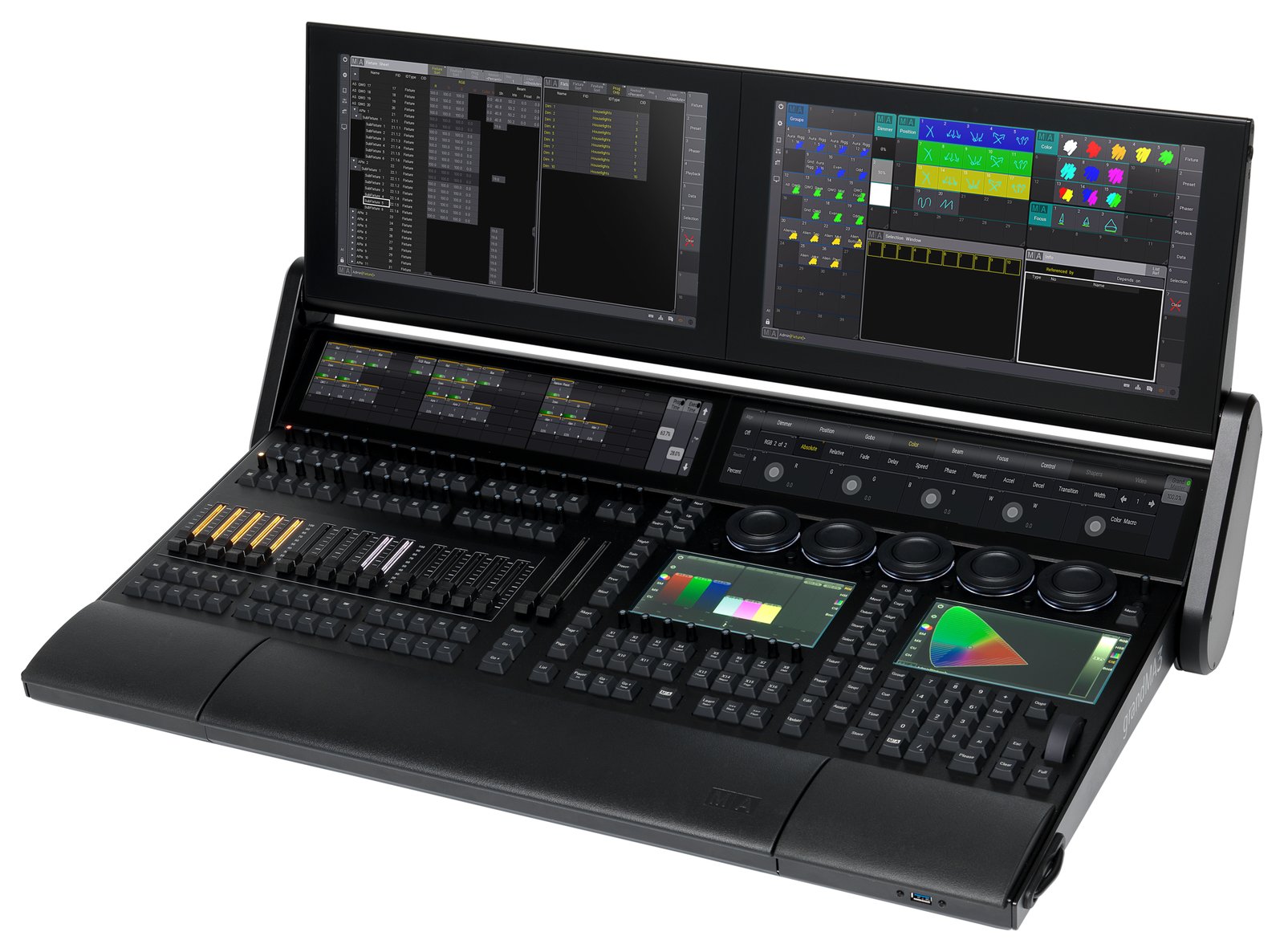
    For touring and large events, the grandMA series from MA Lighting is the platform to beat — the control standard on a huge share of the world’s major shows. If you work your way up through festival and concert lighting, this is the desk you keep meeting. This guide covers the current grandMA3 and the still-everywhere grandMA2. For the bigger picture, see our professional buyer’s guide; for the company behind it, see our MA Lighting overview.

    grandMA3 — the current range

    grandMA3 is MA’s current generation, with a built-in 3D visualizer and native GDTF support. It comes in full-size, light, compact and onPC forms, scaling from a laptop setup to the largest touring rigs while keeping one consistent workflow across every tier. The integrated visualizer means a programmer can pre-build and preview a show without the physical rig in front of them, and native GDTF aims to make fixture data portable and consistent rather than trapped in a proprietary library. That range of hardware forms is deliberate: a designer can prep on onPC, rehearse on a compact desk and run the show on a full-size console without relearning anything.

    grandMA2 — still everywhere

    Production of grandMA2 has ended, but it remains heavily used in rental and touring inventories — and on riders. The grandMA2 light offers 4,096 parameters, 15 motorized faders and two touchscreens; the ultra-light offers 4,096 parameters and 6 DMX outputs. It’s a mainstay of the used market, and its continued presence on riders means a working operator still needs to be fluent on it. For many productions, a grandMA2 remains a completely capable desk, and the depth of the installed base is exactly why it hasn’t disappeared the way discontinued gear usually does. When you’re evaluating a purchase, that liquidity — easy to rent, easy to resell, easy to staff — is part of the value.

    The onPC and offline workflow

    A large part of grandMA’s practical appeal is how much you can do without the full-size desk in front of you. The onPC software runs the same environment on a laptop, so a programmer can build and refine an entire show at home, walk into the venue with the file ready, and spend precious tech time polishing rather than starting cold. Paired with command and fader wings, onPC can even drive modest shows outright, and it doubles as a backup that mirrors the main desk. That continuity between laptop and console is exactly what a rider standard needs: the same skills, the same files and the same muscle memory carry from preparation through rehearsal to the show itself, whichever hardware tier you end up sitting at on the night.

    Why grandMA dominates touring

    Three reasons: it’s the rider standard, so you can always find a trained operator; it scales to the biggest rigs without running out of headroom; and it’s battle-tested on years of the world’s largest shows. That ecosystem is as much the product as the hardware. A rider standard feeds on itself — because the top shows specify it, rental houses stock it, training courses teach it, and the next production specifies it too, which keeps the pool of operators and gear deep enough to de-risk a major tour. Buying into grandMA is buying into that whole support structure, not just a control surface, and that is what makes it so hard to displace at the top end.

    Le Faisceau Rating — grandMA consoles

    Rated with our Le Faisceau rating method (capacity 25% · programming and workflow 30% · ecosystem and networking 15% · value for money 20% · reliability and support 10%). Specs and prices sourced from manufacturer sites and specialist dealers.

    Console Capacity Workflow Ecosyst. Value Reliab. Overall /5
    grandMA3 full-size 5.0 4.8 4.9 3.2 4.8 4.5 ★★★★½
    grandMA3 light 🏆 Best choice 4.8 4.8 4.9 3.5 4.8 4.6 ★★★★½
    grandMA3 compact 💰 Best value 4.3 4.6 4.9 4.1 4.7 4.5 ★★★★½
    grandMA2 full-size 4.6 4.7 4.6 4.0 4.7 4.5 ★★★★½

    🏆 Best choice : grandMA3 light — highest overall rating (4.6/5).

    💰 Best value : grandMA3 compact — best value-for-money axis (4.1/5).

    FAQ

    grandMA2 or grandMA3?

    grandMA3 is the future-proof choice and where the platform is heading; grandMA2 (or a grandMA3 running in MA2 mode) remains relevant for existing setups and the used market. Base the decision on what your shows and rental partners actually run today versus where you want to be in a few years.

    Can I program grandMA on a laptop?

    Yes — grandMA onPC runs the software on a computer, so you can build and rehearse a show offline and keep a ready backup. See our control software guide.

    Why is grandMA worth the investment?

    Beyond the hardware, you’re buying into the deepest pool of trained operators and rental stock in the business, which is precisely what makes it the safe specification for a large, high-stakes production.

    Photo credit: Photo: Hullian111, CC BY-SA 4.0, via Wikimedia Commons

  • ETC Eos Lighting Consoles: The Family Guide

    ETC Eos Lighting Consoles: The Family Guide

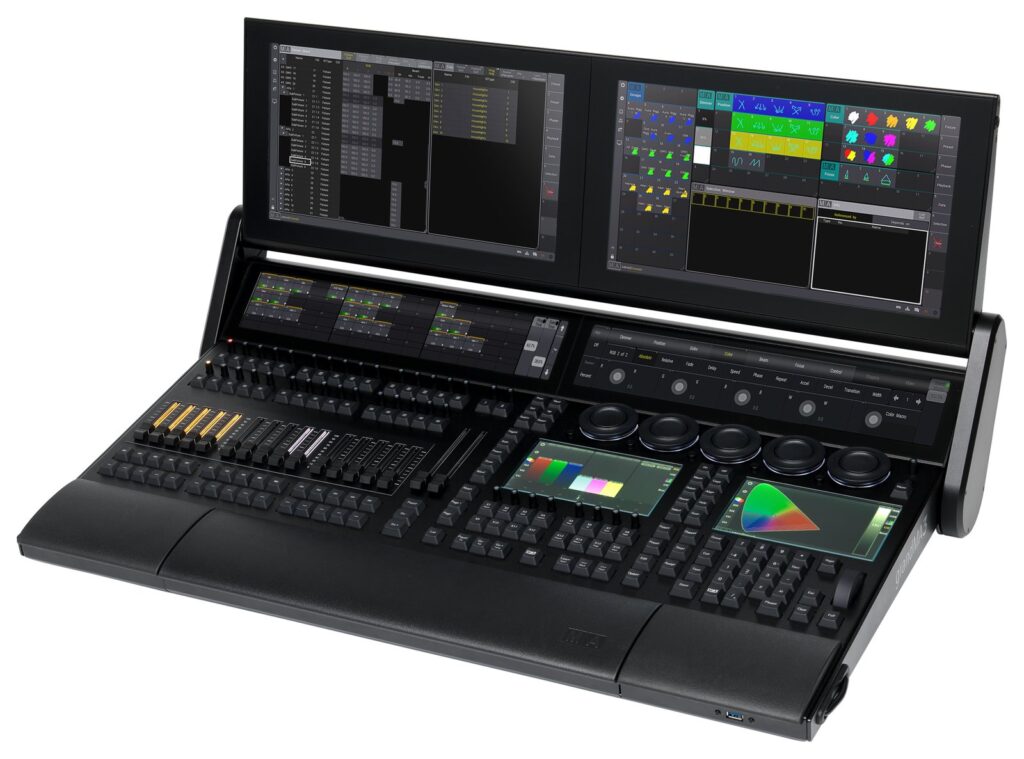
    If you work in theatre, one name dominates: ETC (Electronic Theatre Controls) and its Eos family of consoles. From education desks to flagship rigs, the whole range runs the same Eos software — which is the single most important fact about the family, because it means the skills you build on the smallest board carry straight up to the largest. This guide walks through the family and where each model fits. For the wider landscape, see our guide to professional DMX lighting controllers.

    The Eos family at a glance

    • Eos Apex (5 / 10 / 20) — the flagship; the Apex 20 drives 24,576 outputs for the largest productions.
    • Gio @5 — 4,096–24,576 outputs, five motorized faders and an 18.5″ touchscreen; a compact workhorse with flagship reach.
    • Ion Xe / Ion Xe 20 — 2,048–12,288 outputs; the Xe 20 adds 20 faders for hands-on submaster control.
    • Element 2 — 1,024–6,144 outputs; the entry into the Eos family and a common choice for schools.
    • ETCnomad — the Eos software on PC/Mac, for offline programming and learning (see our control software guide).

    The pattern is clear: outputs and fader counts climb as you move up the range, but the software and workflow stay identical, so choosing a model is mostly a question of how big a rig you need to drive and how much hands-on surface you want. Specs: etcconnect.com. Prices via a specialist dealer.

    Picking a model in the family

    Because every desk shares the Eos software, choosing a model comes down to two practical questions: how many outputs your rig needs now and in the near future, and how much physical control surface you want under your hands. A school or small theatre running mostly conventionals and a few LED fixtures is well served by the Element 2, while a busy regional house with moving lights will appreciate the extra outputs and faders of an Ion Xe or Gio @5. Buy for the rig you’re growing into rather than the one you have today, and remember that ETCnomad lets you learn and pre-program on a laptop no matter which console you eventually sit down at.

    Why theatre chooses ETC

    Eos is built around cue-based (tracking) operation — write a show once, play it back identically every night — which is exactly what theatre, opera and dance need. Tracking means a value stays put until you deliberately change it, so editing a large cue stack becomes fast and surgical rather than a matter of re-recording every state. Add proven reliability in institutional venues and a coherent ecosystem (Source Four fixtures, dimmers, networking that all speak the same language), and you have a platform people learn once and use everywhere. That combination of a purpose-built workflow and industry ubiquity is why a designer trained on Eos can walk into venue after venue already fluent.

    ColorSource is not Eos

    ETC also makes the ColorSource line — a separate, simpler platform that does not run Eos software. It’s an excellent affordable console in its own right for schools, worship and small venues, but it is not the command-line, cue-based Eos environment, and a programmer expecting Eos depth will find it limited. For the professional Eos environment, the Element 2 is the entry point, not the ColorSource. Knowing this distinction before you buy saves real disappointment: if you want the Eos workflow, start at the Element 2; if you want simple, friendly control at the lowest price, ColorSource may be the better fit — just go in clear about which one you’re getting.

    Le Faisceau Rating — ETC Eos consoles

    Rated with our Le Faisceau rating method (capacity 25% · programming and workflow 30% · ecosystem and networking 15% · value for money 20% · reliability and support 10%). Specs and prices sourced from manufacturer sites and specialist dealers.

    Console Capacity Workflow Ecosyst. Value Reliab. Overall /5
    Eos Apex 20 5.0 4.7 4.6 3.3 4.9 4.5 ★★★★½
    Eos Gio @5 4.7 4.7 4.6 3.8 4.9 4.5 ★★★★½
    Eos Ion Xe 4.3 4.6 4.6 4.3 4.9 4.5 ★★★★½
    Eos Element 2 💰 Best value 3.9 4.4 4.5 4.5 4.8 4.4 ★★★★½

    💰 Best value : Eos Element 2 — best value-for-money axis (4.5/5).

    FAQ

    Which Eos console for a mid-sized venue?

    The Ion Xe is the classic workhorse for mid-sized rigs; step up to a Gio @5 for more outputs and a built-in touchscreen. Both run the identical software, so the choice comes down to output count and how much physical surface you want.

    Is there a free way to learn Eos?

    Yes — ETCnomad runs the Eos software on a computer for offline programming and practice, so you can build real fluency before you ever sit at a hardware desk.

    Do I need the flagship Apex for a school?

    No — the Element 2 gives you the full Eos workflow at the family’s entry price, and the skills transfer directly if you later move up to a larger desk for a bigger production.

    Photo credit: Photo: Masonvanmeurs, CC BY-SA 4.0, via Wikimedia Commons

  • Wireless DMX Control: A Professional Guide

    Wireless DMX Control: A Professional Guide

    Cutting the DMX cable is tempting — no more runs across a stage, faster get-ins, and fixtures placed where cable simply can’t reach. But professional wireless DMX is a world apart from the cheap wireless boxes sold to hobbyists, and treating the two as equivalent is how shows end up flickering. This guide covers the two standards that run the professional world, how they now work together, and where wireless fits in a serious rig. For the wider context, see our guide to professional DMX lighting controllers.

    The two professional standards: W-DMX and CRMX

    Since 2008, two technologies have led professional wireless DMX: W-DMX (from Wireless Solution) and CRMX (from LumenRadio). For years the industry was split between the two camps, which meant matching transmitters and receivers from the same family or accepting that gear from one wouldn’t talk to the other. Both were built for the demands of real production — frequency-hopping to survive crowded radio environments, and link stability an operator could trust on a paying show — which is exactly what set them apart from consumer wireless. Understanding that there were two rival professional standards is the key to making sense of the older gear still in circulation. (Sources : LumenRadio, PLSN.)

    One unified solution

    That divide is closing. After LumenRadio acquired Wireless Solution in 2020, the two technologies were combined into a single solution: fixtures can listen to both W-DMX and CRMX and automatically select whichever protocol the transmitter uses — no mode switching, no manual configuration, the link sets itself up. In practice, that means you can now drive wireless fixtures regardless of which camp the transmitter belongs to, which removes one of the oldest headaches in wireless DMX. For anyone specifying new gear it simplifies the decision considerably, and for rental houses it means a more interoperable inventory, though a mixed bag of older transmitters and receivers on a shelf still rewards a careful check before the truck rolls.

    How wireless DMX fits a professional rig

    The principle is simple: a transmitter sits at the console or a node and broadcasts the DMX; receivers built into (or attached to) the fixtures pick it up and hand off real DMX to the light. What separates pro gear is reliability under heavy RF conditions — festivals and arenas are crowded radio environments full of comms, Wi-Fi and other wireless links — plus solid range and link stability that hold up across a whole show. The best results come from treating the wireless link as a system to plan, not a magic fix: antenna placement, line of sight and a clear picture of what else is transmitting nearby matter as much as the badge on the box.

    Wireless DMX is not wireless console control

    An important distinction: wireless DMX replaces the DMX cable to the fixtures. It is not the same as remotely controlling the console itself — that’s a separate remote or app feature that lets you walk the room with a tablet while focusing lights. The two solve different problems, and conflating them leads to planning mistakes. Wireless DMX gets signal to fixtures you can’t easily cable to; wireless remote control gets the operator away from the desk. A show might use both, neither or just one, so it’s worth being precise about which you actually mean when you spec a rig, because ordering the wrong kit for the job is an easy and costly mistake to make on paper.

    FAQ

    Is wireless DMX reliable enough for shows?

    Professional systems are used on major tours and broadcasts every day. Reliability comes from quality hardware and good RF planning — antenna placement, line of sight and awareness of the local radio environment — not from the cheapest transmitter you can find.

    Do transmitter and receiver have to match brands now?

    With the unified W-DMX / CRMX solution, cross-compatibility is the direction of travel — modern fixtures auto-select the transmitter’s protocol. Older, single-standard gear may still need matching, so verify before you rely on a mixed inventory.

    Is wireless DMX the same as controlling the console remotely?

    No. Wireless DMX replaces the cable to the fixtures; wireless remote control moves the operator away from the desk. They’re separate features that solve different problems.

    Photo credit: Unsplash

  • DMX Lighting Control Software for Professionals

    DMX Lighting Control Software for Professionals

    Professional lighting control software is, in essence, the PC version of a console. It lets you program a show offline on a laptop, run a small rig through a hardware interface, or keep a ready backup of a full desk — all using the same environment the professionals already know. It has little to do with the free hobby apps aimed at DJs, which are separate products built to a different standard. Here’s what pro control software is, the major options, and why working operators rely on it. For the bigger picture, see our guide to professional DMX lighting controllers.

    What “onPC” software actually is

    The leading manufacturers ship a software version of their console — usually called onPC. It runs the very same software as the hardware desk, so a show file moves between laptop and console without translation or conversion. That continuity is the whole point: you learn one environment and use it everywhere, and the file you build on the plane is the file you run at the venue. Crucially, this is not a stripped-down imitation of the console — it’s the identical application, just running on general-purpose hardware instead of the manufacturer’s chassis. What differs is the physical surface and, usually, how much DMX you’re licensed to output. In every other respect the environment is the same one the manufacturer’s flagship runs, which is why time spent learning onPC is never wasted — it is direct, transferable experience on the real platform.

    The major platforms’ software

    • ETC Eos — Eos Nomad (the Eos software on PC/Mac).
    • ChamSys — MagicQ PC.
    • High End / Hog — Hog 4PC.
    • MA Lighting — grandMA onPC.

    Each offers different output tiers and licensing depending on how much DMX you need to drive, from a handful of free universes for learning up to full show output with the right dongle or license. Because these mirror the flagship desks, the software you learn at home is a direct on-ramp to the hardware you’ll meet on the job.

    Why professionals use it

    • Offline programming — build the show before you reach the venue, so tech time is spent refining rather than starting from zero.
    • Training — learn the real environment without tying up a desk that’s needed for a show.
    • Backup — a laptop running onPC is a cheap insurance policy mid-show, ready to take over if the main surface fails.
    • Affordable entry — the software route is the least expensive way into a professional platform, letting you build career-relevant skills for little more than the cost of a laptop.

    Those four uses reinforce each other: the same free download that teaches a student the platform is also the tool a touring programmer uses to prep and to back up. That is why onPC has become a standard part of how professionals work rather than a beginner’s compromise.

    Software plus hardware

    To send real DMX, the software needs a hardware path: a manufacturer dongle, a network node (Art-Net / sACN to DMX), or a command wing that adds physical faders and encoders. The division of labor is simple — the software programs and stores the show; the interface turns that data into signal the fixtures can act on. That split is also what keeps the entry cost low: you can learn and program with nothing but the free application, then add only the output hardware you actually need when it’s time to light real fixtures.

    FAQ

    Is professional control software free?

    Some versions are free to download for offline programming, with a paid dongle or license required to output a meaningful number of DMX universes. The learning and prep are effectively free; you pay when you need to drive a real rig.

    Can software replace a full console?

    For preparation and backup, absolutely. As a main desk in heavy use, it depends on the command surface and the show — a command wing narrows the gap, but a busy busking gig still benefits from a full hardware surface. See our professional buyer’s guide.

    Is onPC the same software as the console?

    Yes — it’s the identical application, not a cut-down imitation. What changes is the physical surface and, usually, how many DMX universes you’re licensed to output, which is why a show file moves between laptop and desk without any conversion or loss.

    Photo credit: Unsplash

  • Lighting Desks: A Professional Guide

    Lighting Desks: A Professional Guide

    In the UK and across the touring world, professionals don’t say “controller” — they say lighting desk. The word itself is a signal: a desk is a serious programming and playback instrument for real production work, a world away from the cheap boxes sold to hobbyists. This guide explains what a professional lighting desk does, the platforms that matter, and how to choose one for your work. For the wider picture, see our guide to professional DMX lighting controllers.

    Desk, console or controller?

    They broadly describe the same thing, but the register differs. In the UK, the trade term is lighting desk; in the US, lighting console; “controller” is the catch-all that also covers entry-level and DJ gear. If a product leads on its low price, it isn’t a professional desk. The vocabulary is worth learning because it tells you who a product is aimed at: a manufacturer selling to touring professionals talks about desks and consoles, while one chasing the hobby market leads on how cheap and simple its controller is. When you read a spec sheet, that framing is a useful first filter before you even reach the feature list.

    What a professional desk has to do

    Whatever the badge, a desk earns its keep on a few things:

    • Reliability and redundancy — it has to run a whole show without faltering, and offer a backup if the hardware fails, so a single fault doesn’t black out the stage.
    • A pool of trained operators — on an industry-standard desk you can always find someone to programme or operate, and it’s often what the rider specifies in the first place.
    • Networking and scale — real rigs run over Art-Net and sACN across many universes, distributing control over Ethernet rather than a tangle of separate DMX lines.
    • Offline tools — a PC version to programme away from the venue and keep a backup ready on a laptop.

    These are the qualities that separate a professional instrument from a toy, and they matter most precisely when things go wrong: the show that never stops, the operator who can always be replaced, the rig that scales without a rebuild, and the backup already programmed and waiting. None of them show up in a glossy photo, which is exactly why the hobby market rarely mentions them.

    The desks that matter

    • ETC Eos — the theatre standard, built around cue-based operation and a firm favourite in scripted work.
    • grandMA (MA Lighting) — the touring and large-event standard, the rider default at the top end.
    • ChamSys MagicQ — a British favourite, known for value and genuinely free software.
    • Avolites — a British make with a strong following in events, on Titan software.

    Between them these four cover the overwhelming majority of professional work, and each has carved out a home discipline — Eos in theatre, grandMA on the biggest tours, ChamSys and Avolites strong in live and events, particularly in the UK. Detailed model guides are on the way, but knowing the landscape is enough to start narrowing your choice.

    Choosing a desk for your work

    • Theatre — cue-based, repeatable programming: Eos territory, where writing a show once and replaying it identically is the whole job.
    • Live and touring — fast, reactive operation: grandMA, Avolites or ChamSys, built for busking a show on the fly.
    • Events — flexibility and quick turnarounds, where a desk you can programme fast and adapt on the day earns its keep.

    Start from how you actually work, then weigh the criteria above. Don’t pick a desk on its feature list alone; pick it on the kind of shows you do and the pool of operators and rental gear around it, because the best instrument is the one you can staff, support and trust on the night. Our professional buyer’s guide takes you through the full decision.

    FAQ

    Is a lighting desk the same as a lighting console?

    Yes — “desk” is simply the British term for what Americans call a console. Both mean a professional programming and playback instrument, and the difference is purely one of local vocabulary rather than the gear itself.

    Which lighting desk should a smaller venue choose?

    Look at how many fixtures you run and whether you need moving lights, then favour a desk with a healthy local pool of operators and solid support. A capable mid-range desk on a well-supported platform will serve a small venue far better than an underpowered box you’ll soon outgrow.

    Photo credit: Unsplash

  • What Is a DMX Controller? A Professional Explainer

    What Is a DMX Controller? A Professional Explainer

    A DMX controller is the device that tells your lights what to do. It sends digital instructions — over the DMX512 protocol — to dimmers, LED fixtures, moving heads and more, setting each one’s intensity, color and movement. In short, it’s the brain of a lighting rig, and everything else in the system exists to carry out its commands. This explainer covers what DMX is, what a controller actually does, and where the line sits between a hobby box and a professional console.

    What DMX actually is

    DMX512 is the standard digital language of stage lighting. A single DMX universe carries 512 channels, and each channel is one instruction — for example, the intensity of a dimmer or the red value of an LED. A fixture uses one or more channels depending on its features: a simple dimmer needs just one, while a moving head with pan, tilt, color, gobo and more can consume a couple of dozen. When a rig outgrows 512 channels, you simply add more universes, and modern networks carry many of them over a single Ethernet cable. That channel-by-channel model is what makes DMX so flexible: any fixture that speaks it can be patched into the same system regardless of who made it.

    What a DMX controller does

    Three core jobs:

    • Patch — tell the controller which fixtures are connected and at which addresses, so it knows what each channel is talking to.
    • Program — build looks, cues and effects, from a simple color wash to a timed sequence that runs itself.
    • Play back — trigger those looks live, on faders, buttons or a timed sequence, in the order the show demands.

    A basic controller might only set channels manually, one level at a time; a professional console adds programming depth, effects engines, networking across many universes and the reliability to run a whole show without faltering. The gap between the two is less about the number of knobs and more about how much the desk can do for you when the pressure is on.

    Controller vs console: hobby vs professional

    “DMX controller” is a broad term. At the cheap end it means DJ boxes and free software with a USB dongle — fine for a few simple fixtures and static looks. At the professional end, people say lighting console (US) or lighting desk (UK) — a serious instrument built for real production work, with the programming depth and reliability a paying show requires. The word on the box tells you little; the feature set and build quality tell you everything. If you’re choosing for professional use, start with our guide to professional DMX lighting controllers.

    Universes and channels: how big can it get?

    The size of show a controller can run is defined by how many channels — outputs, or parameters — it can drive. Small rigs live happily in one or two universes; large touring and theatre rigs run dozens, distributed over a network using Art-Net and sACN. Those network protocols pack many universes onto ordinary Ethernet, so a single cable can carry what once demanded a tangle of separate DMX lines, and nodes convert the network back to physical DMX right where the fixtures hang. When you compare controllers, output count is the clearest measure of how far each one will scale as your rig grows. Knowing that maximum up front saves you from buying a desk that can’t keep up — it’s the single specification that most often forces an early, avoidable upgrade, so it’s worth pinning down before anything else.

    FAQ

    Do I need a DMX controller?

    If you want to control more than a couple of simple fixtures — and especially anything with color or movement — yes. It’s what makes coordinated, repeatable lighting possible instead of a manual scramble at the wall dimmer.

    Hardware controller or software?

    Both exist. Professional platforms offer a PC version that drives DMX through a hardware interface — a flexible, affordable way to learn a real environment and keep a backup ready. See our professional buyer’s guide for the full picture.

    What’s a DMX universe?

    One universe is 512 channels of control. Each fixture uses one or more channels, and when you run out you add another universe — large rigs simply run many universes over a network.

    Photo credit: Unsplash

  • Professional DMX Lighting Controllers: Choosing the Right Console for the Job

    Professional DMX Lighting Controllers: Choosing the Right Console for the Job

    Search “DMX controller” online and you’ll drown in eighty-dollar DJ boxes and free software dongles. None of them will get you through a show that actually matters. This guide is for working professionals — theatre, touring, corporate and live events — who need a console they can trust under pressure. We’ll cut through the hobbyist noise, define what “professional” really means in lighting control, and map the platforms the industry actually runs on. New to all this? Start with what a DMX controller actually is.

    Controller, console or desk?

    The words matter, because they signal who a product is built for.

    • In the US, working professionals talk about a lighting console (or, loosely, a controller).
    • In the UK and much of the touring world, it’s a lighting desk.
    • The cheap “DMX controllers” that flood online stores — DJ-oriented boxes, basic fixture controllers, free software with a USB dongle — are a different world entirely.

    A professional console is a programming and playback instrument built for reliability, scale and repeatability. If a product’s headline feature is its price, it isn’t one.

    What makes a controller “professional”?

    Forget the spec sheet for a moment. These are the things that decide whether a console survives real production work.

    • Reliability and redundancy. Can it run for weeks without a reboot — and what happens if it fails mid-show? Professional platforms offer backup / tracking redundancy so a single hardware fault doesn’t kill the lights.
    • A trained-operator ecosystem. A console is only as good as the person driving it. Industry-standard platforms mean you can always find someone to operate, cover or take over — and they’re often what the rider demands.
    • Network and scale. Real rigs run over Art-Net and sACN, addressing dozens of universes. The number of outputs (parameters) a console can drive defines the size of show it can handle.
    • Software and offline tools. Professional platforms run on a PC (onPC / software) so you can program offline, train an operator, or keep a backup ready without the full desk.
    • Total cost of ownership. The sticker price is the tip of the iceberg: training, wings and extensions, maintenance and resale value all count. A “cheap” console nobody can operate costs more than a well-run standard.

    The professional platforms at a glance

    A handful of platforms run the professional world:

    • ETC Eos — the theatre standard, built around cue-based (tracking) operation.
    • grandMA (MA Lighting) — the de facto touring and large-event standard.
    • ChamSys MagicQ — known for value and accessibility.
    • Avolites — a strong presence in events and touring, on Titan software.
    • Hog / High End Systems — established in live events, especially in the US.

    Each of these deserves its own deep dive — dedicated model guides are on the way.

    Which console for which job?

    The “best” console depends entirely on the work you do:

    • Theatre / cue-based shows → ETC Eos territory: write a show once, play it back identically every night.
    • Touring / live busking → grandMA, Avolites or ChamSys, built for reactive, on-the-fly operation.
    • Corporate & events → flexible, fast platforms with strong network support and quick turnarounds.
    • Fixed install → reliability and operation by non-specialists come first.
    • Churches & houses of worship → easy operation for volunteers, repeatable services, livestream-friendly.

    Use-case guides covering each of these are on the way.

    Software and wireless control

    Two areas worth flagging early:

    • Control software. Every major platform ships a PC version (Eos Nomad, MagicQ PC, Hog 4PC, grandMA onPC) for offline programming and backup.
    • Wireless DMX. Professional wireless relies on standards like W-DMX and LumenRadio CRMX — a different league from the cheap wireless boxes sold to hobbyists.

    Le Faisceau Rating — our picks by use case

    Rated with our Le Faisceau rating method (capacity 25% · programming and workflow 30% · ecosystem and networking 15% · value for money 20% · reliability and support 10%). Specs and prices sourced from manufacturer sites and specialist dealers.

    Console Capacity Workflow Ecosyst. Value Reliab. Overall /5
    Eos Ion Xe 4.3 4.6 4.6 4.3 4.9 4.5 ★★★★½
    MagicQ MQ70 💰 Best value 4.2 4.4 4.6 4.7 4.4 4.4 ★★★★½
    grandMA3 light 🏆 Best choice 4.8 4.8 4.9 3.5 4.8 4.6 ★★★★½
    Avolites Tiger Touch II 4.2 4.6 4.4 4.3 4.5 4.4 ★★★★½
    Obsidian NX1 3.9 4.3 4.3 4.6 4.2 4.3 ★★★★½

    🏆 Best choice : grandMA3 light — highest overall rating (4.6/5).

    💰 Best value : MagicQ MQ70 — best value-for-money axis (4.7/5).

    FAQ

    Is a DMX controller the same as a lighting console?

    Loosely, yes — but in professional use, “console” (or “desk” in the UK) implies a serious programming and playback instrument, while “controller” often refers to entry-level or DJ gear. Intent matters more than the label.

    What consoles do professionals actually use?

    On major tours, in theatre and in broadcast, you’ll most often find ETC Eos and grandMA, with ChamSys and Avolites widely used across events.

    What’s the most affordable way into a professional console?

    The software route. Run a platform’s PC version (onPC / Nomad / MagicQ PC) with a hardware node or wing: you learn the real environment for a fraction of the price of a full desk.

    The bottom line

    Choosing a professional DMX lighting controller isn’t about finding the “best” box — it’s about matching a platform’s workflow, ecosystem and reliability to the work you actually do. Start from your use case, weigh the criteria above, and never treat redundancy as an afterthought.

    Photo credit: Unsplash

    Read also: Stage lighting control system: how it works and how to design one